About 6 years ago I ran more than 57 tabletop RPG sessions in 3 months – while working full time as a senior game designer.
Nearly all of it was original content.
My goal was to challenge myself to learn how to design and iterate faster. By improving the speed at which we can make things, we can make more total things. We can try out more ideas, then cut to a higher quality top %.
If you read my work, you probably want to level up on design. Learning new stuff is great, but practicing applying it faster and faster is key too.
It’s like learning to throw a baseball from a textbook, you still need to practice throwing it until it’s easy to do fast and accurately in the middle of a game.
So I set a goal – I wanted to comfortably design enough content for 3x original tabletop RPG adventures each week, in about 90 minutes of prep each night between sessions.
To do this, I needed better tools.
Here’s one I developed to accelerate dungeon design. I’ve used it ever since in my videogame projects too.
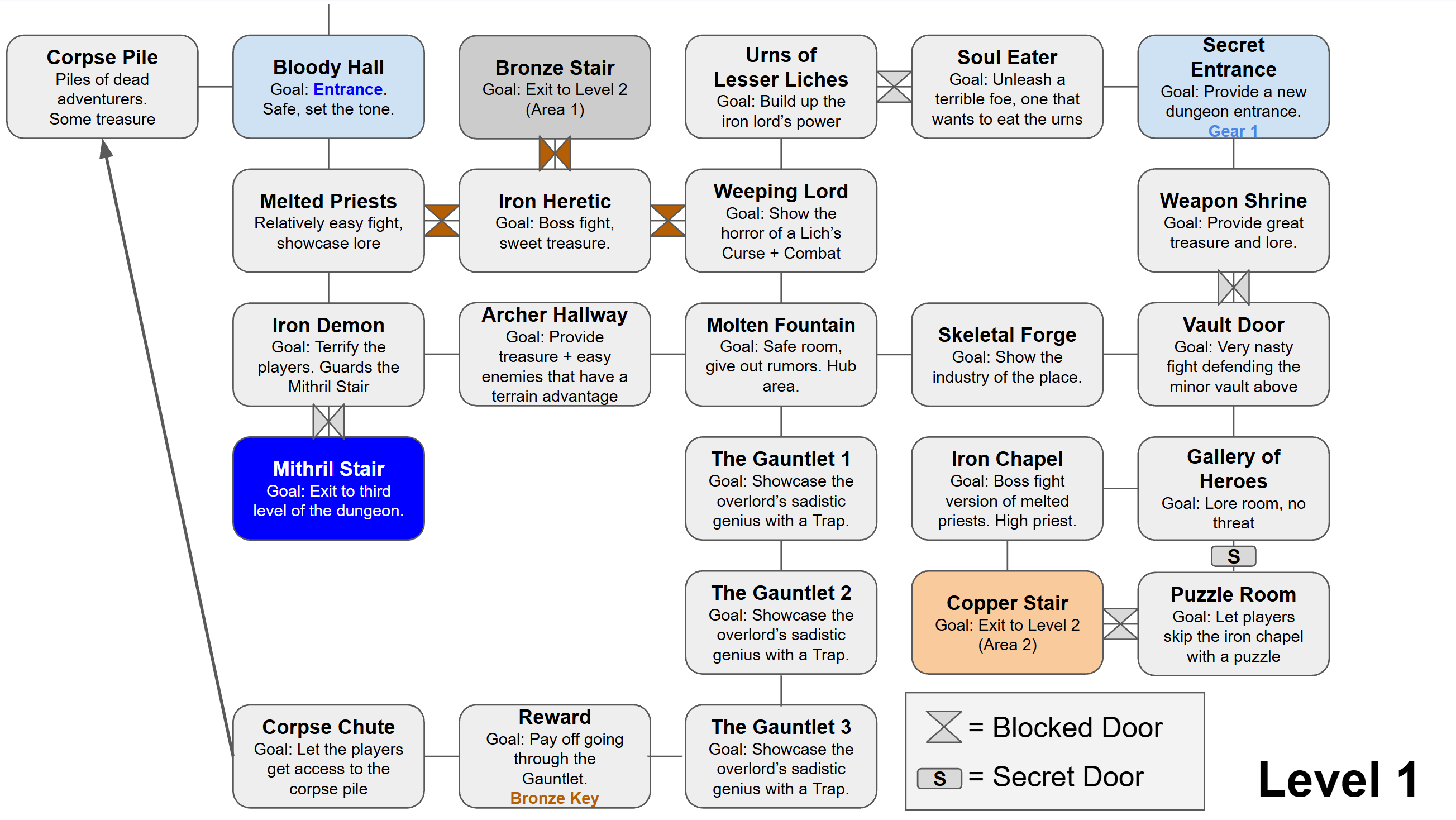
This is the first level of one of my campaign’s mega-dungeons: The Vaults of Iron.
Pilgrims that passed the deadly trials are granted eternity encased in sacred iron, preparing to defend the realm against an invasion that the Iron Lord assures them will take place centuries hence. Throughout the early levels are the tormented failures that died, or worse, in the attempt.
It also has a lot of treasure.
Designing great mega-dungeons, labyrinthine complexes that take many sessions to explore, is a pet project of many GMs. The great ones are legendary, but they often take forever to build and wear out their welcome relatively fast.
Small pacing issues can kill player excitement and they can easily feel repetitive. Getting them right usually takes a very long time, as you explore concepts and move ideas around.
The biggest challenge is often knowing where to start. What layout of rooms will produce a satisfying experience? You have tons of ideas, but where to put them? How do you evaluate if the layout makes sense? Often it feels paralyzing and this uncertainty-based paralysis is the main slowdown.
So I challenged myself to design a dungeon level and iterate on it multiple times in 2 hours. To solve that problem, I needed to cut out anything that wasn’t critical.
There are two critical questions in each room:
- Why is this room here? What’s the purpose? What’s the designer’s goal that the room needs to fulfill?
- What concept would fit that design goal? Can figure out the details later.
To be clear: I had no idea when iterating on this what “The Gauntlet 2” would contain. All I knew was I liked the idea of a “gauntlet” of sadistic/evil/unfair deathtraps you could opt into that showcased the Iron Lord’s genius and cruelty. I like to say “A dungeon should be an expression of the character that created it”.
This let me consider spatial relationships and spot potential issues earlier in the process, before zeroing in on each room’s design.
For example – I recognized that if I wanted to make a 3-room deathtrap gauntlet, I should let players opt into the experience. That way they’d feel like they were adequately warned on what they were about to get into, and I’d have more social permission to get evil.
I’d originally thought of opening with the deathtrap gauntlet, or funneling into it to go to level 2 as the climactic level 1 experience. I recognized at this point, using this tool, that wasn’t going to work.
So I started moving rooms to create a different tone-setting intro that would funnel them into a central hub, branching off in 3 directions. One of those would be the Gauntlet. The others would loop back into an alternate way to level 2.
At this point I also recognized that they needed an alternate path to leave/re-enter the dungeon without passing the Mithril Demon. They weren’t going to kill it anytime soon (maybe ever) so while it made a great impression I didn’t want to have them take crazy damage at the start of every future session.
So I put a secret entrance to the dungeon on the non-gauntlet loop that branches off the mithril fountain. With 2 paths leading there, I could be reasonably confident they’d run across it while exploring. If they got the Bronze Key instead, they’d be able to go straight to the Bronze Stair down to Level 2 from the main entrance instead (before dealing with the Iron Demon).
Both would work.
Lots of level designers use high level blockouts in the game industry, but I’ve rarely seen versions that aren’t just listing what is in each room – but focusing on the designer’s goal for why the room is there. Starting with that makes everything so much easier.
I call this tool a “Goal-Blueprints”. If specifically talking about Dungeons, you can call it a Dungeon-Schematic to sound cooler.
It’s also fun to hand a map like this to another designer as a “dungeon kit” and let them create their own versions of each room based on these goals.
Try it yourself, feel free to steal it. It’s a lot of fun.

