Just ran a 5-hour session on how to design monetization systems. So many studios miss the beautiful reality of games: designers are alchemists. If you know what you’re doing, your designs can increase the value of your game’s goals and rewards.
If something feels like it’s worth $5, then you have a lot of trouble charging more than $5 for it. But if it feels like it’s worth $50, then you can charge $35 and still make it a great deal. You can also give it away for free as part of an event or retention goal, and that feels great too.
Focus on value creation, not value extraction.
Here’s an example: if your game has cosmetic skins for weapons, create a special cosmetic or applied effect that unlocks once you have collected ALL of them. Better yet – unlock a lesser version earlier and then upgrade it to its final form at specific milestones of # collected.
This adds secondary value to every weapon skin in the game, for very little scope cost. Now if I see a skin that doesn’t appeal to me on an event reward, it’s still one more skin toward this collection goal. We’ve increased the value of acquiring each skin.
Player housing is another example. If my friends never have a reason to visit my house as part of normal activities, then my house or island’s cool decorations feel less valuable. If there’s reasons go there regularly, like being able to gather free resources from the community garden or use a magical altar in my house while i use the portal in yours (we coordinated to build different things, so we’d both have access to an altar and a portal) then the value of both the special features (altar, portal) and the cosmetic decorations of the house go up significantly… Just like foot traffic increases the value of real estate in the real world.
Now… What happens if our player housing features also help us unlock extra weapon skins, to progress toward that super-cosmetic? 🙂
Let’s talk about Completion Bias. We have a strong drive to finish incomplete tasks, espescailly if there is a visual indicator. We prefer holes to be filled in, progress bars to be filled up. Simply seeing an “incoimplete” object creates an impulse to finish it.
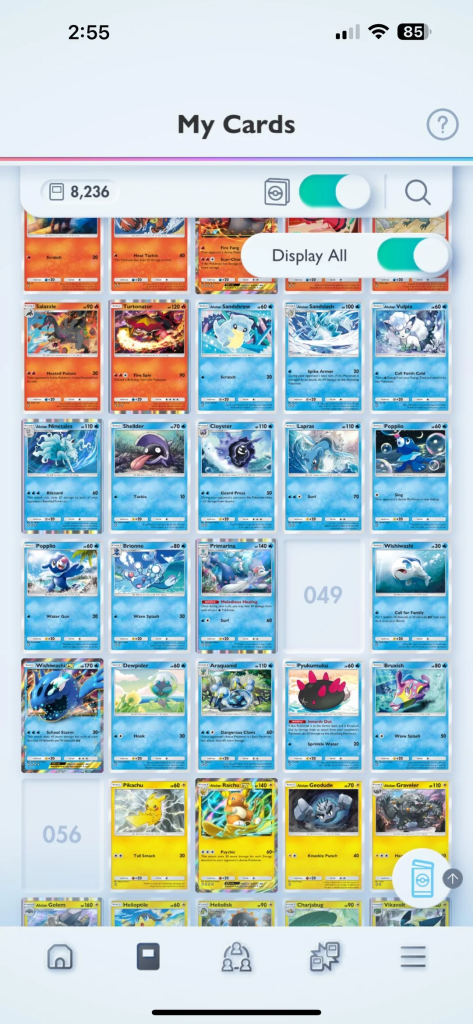
Pokemon TCG Pocket nails this idea. When you get a new card, they show its slotting into a dedicated space for it in your “binder”. You can visually see the gaps in your collection filling in each time you open a pack.
This mirrors real-world player behavior. Players looking to complete a specific collection will often create binders with dedicated slots for each card, then fill the slots as they go.
But that’s not what makes this impressive. This is impressive because the gaps can make you to care even if you normally don’t!
As someone who normally never cares about completing a collection in a cardgame, just going for the cards I use for decks, this was enormously effective. I kept opening packs from sets long after I had every useful card for gameplay in them. I was hunting the last few cards to fill those gaps.
It wasn’t even tied to a reward. It just felt satisfying.
Great visual design like that can be out of scope for some projects, and hard to incorporate mid-development… So here’s an example from my own work nearly any game can use:
Legends of Runeterra’s PvE mode is a Hero Collector with roguelite progression. Initially the team expected players would “main” a favorite champion, much like they mained a favorite champion in league of legends or a favorite deck in LoR’s PvP mode.
If that happened, the vast majority of content in the game would feel irrelevant to players. We needed to shift players to thinking about collecting all the champions, not just their few favorites.
The first step was the simplest: putting a X/Total Champions, X/Total Levels and X/Total Stars tracker at the top of the Champion Roster screen. As simple as it is, this screen is the pillar that holds up the entire mode.
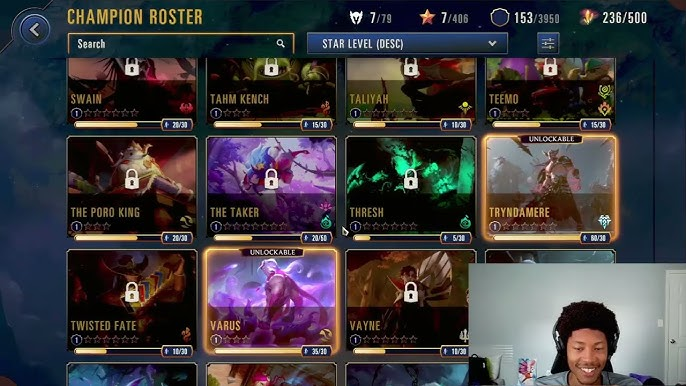
Those simple X/Total progress trrackers at the top of the screen communicated signposted the mode’s intentions, and made players want to max them out, while also showing your current progress towards those goals. It also made it easy to share your collection’s progress in a screenshot; increasing the social value and helping player’s give eachother advice about what to work on next.
Originally, this UI screen was just meant to be a functional way to select a hero. These elements transformed it into a display case for your collection.
You’ll also notice this UI also uses progress bars under each champion to show how close you are to upgrading them to their next Star Power. These bars have an interesting history in the project.
At first these bars didn’t exist at all, because we wanted to keep the UI as clean as possible. Good goal. However, these bars are motivation rocket-fuel. Whenever you get more fragments that progress a character (you need a certain number ofVarus fragments to unlock Varus, then more Varus fragments to unlock his super-shiny, exciting star powers) you see the visual impact on your screen. It also helps you plot your next goals, figuring out where to invest your scarce Wild Fragments, which can be used on any champion. You only got about 5 wild fragments each day, and spending a few fragments to fill up one of those bars feels great.
However, this only works because it’s tracking the star progression. It would have been an easy mistake to make these bars show off the champion’s progression to their next Level Up instead of their Star Upgrade. In fact, this almost happened! Everyone was so used to the bars at the bottom of a character being XP bars showing their progress to a new level that they were very surprised when I said we should to change it to track champion fragments instead.
This is what I told the team:
Champions have both Levels and Stars. You gain XP to Level Up a champion by playing with it. It’s an inch-pebble system, meant for rapid but low-impact upgrades to encourage you to try again when you lose a run with the champion. It also creates a reason you have to play with every champion in order to progress them. This gives players a lot of long-term progression goals, which they can pursue at their own pace.
Stars are different: They’re massive upgrades and you use scarce, valuable currencies to upgrade them. They’re one of the big reasons to monetize, and give you major progression milestones. They also provide a way to make progress on champions without playing them, which is also important in this kind of collection game. The longer you ignore a champion, the more random fragments it’s likely to get; making it increasingly attractive to try out if you weren’t interested in that character already. When you finally do try it out, the huge power boost it has compared to other level-1 characters that you tried with fewer stars make for a delightful first impression.
So why is tracking level-ups so much worse than shards? Because level-ups are not monetizable, and players will focus on levelling up only one champion at a time; so seeing my progress to the next level isn’t something I need at the collection level. I never make “incidental” progress toward the next level at the collection screen, there is no “wild XP” currency to spend on levelling up a champion, and champions tend to gain XP is big chunks rather than tiny drips.
By changing the progress bars to add visual impact to your random fragment rewards, making those random fragments push up lots of different bars, we made progress much more visible and satisfying even while it was taking a long time to earn your next star. We also directed the focus to the highest value goal for both players and the game’s business model.
That’s player-dev alignment, where what players enjoy the most is also what’s profitable to create. If that alignment is off, you’re going to have problems. Make sure you get this right.
Of course, there was a lot more that went into making the champions themselves feel wildly valuable; and most of my work on the mode was aimed at adding features, systems, and visuals that made champions feel increasingly good to collect and increasingly valuable to your goals. I’ll write about them some other time.

