You’ve probably seen Jenny Nicholson’s phenomenal documentary on the Star Wars Hotel. If you haven’t, consider watching it after reading this piece, as it’s a fantastic look into real-world level design, theming, gameplay, logistics, and where a sense of “value” comes from through the nerdiest lens possible.
While explaining the booking experience, Jenny makes a comparison to the much be-hated (opposite of beloved) and now-defunct “Spirit Airlines”. Tell me if this sounds like anything in the Videogame Industry:
In the United States, we have an airline called Spirit Airlines.
Everybody makes fun of it, and it’s just kind of universally acknowledged that this is the cheap, awful airline that you only fly on if you have no other choice.
Basically how Spirit’s business model works is, their base ticket cost is insanely low. It’s usually about half the price of the other airlines.
But that half price ticket is going to be the worst flight of your life, in the tiniest chair you’ve ever sat in, bringing nothing with you but the clothes on your back.
This is because Spirit makes every possible amenity cost extra.
Diet Coke costs extra, the little bags of pretzels cost extra, leg room costs extra, bags cost extra, even carry-on bags, even a purse.
I actually don’t think flying Spirit is a bad way to fly.
If you pay for the Diet Coke and the extra legroom and the carry-on luggage, it just becomes a normal flight, just like you’d experience on any other airline.
And with all that stuff added on, you’re not ultimately paying more than another airline. You’re usually paying around the same amount.
So in a practical sense, Spirit is exactly the same as every other airline. They just present the prices in a different way up front.
So, why does everybody hate Spirit? Because of the psychology of it.
Because you see that initial price, and then for each amenity you’re forced to add along the way to get back to that baseline service you’re used to, each thing the airline demands payment for, you feel like you’re being scammed. It makes the airline look duplicitous and stingy.
You’re like, “Ugh, they really want money for a tiny bag of pretzels? Really, guys?” And it’s like, well, on United Airlines, the pretzels aren’t really free either. They’re just factored into the total cost.
But you don’t know that when you’re paying for the ticket, so when you get the pretzels, it feels like a perk. Framing is everything. If you pay extra for every aspect of an experience across many steps of booking, you feel taken advantage of every time it happens.
It makes your relationship with the company feel antagonistic, as if they’re trying to get away with doing as little for you as possible.
And on the other hand, if you opt out of those amenities, if you don’t add them on, you get a lesser experience.
You’ll have saved money, but you’ll also be sitting on the same plane with all the people who did opt into the slightly better experience, and you’ll be watching them get this better service, and that doesn’t feel good either.
That makes you feel poor.
And that is why everyone thinks Spirit Airlines is the scammy, trashy airline, and they feel negatively about flying on it.
^ And that’s also exactly why players often reject F2P monetization. Even when F2P games often offer a similar experience to a premium game if you’re willing to pay $60, just with the flexibility to pay less or more, how you present the experience colors everything else.
So many F2P games try to monetize way too many different things and keep nickel-and-diming players every chance they get. They aren’t classy in how or when they invite the player to go shopping. They’re like an annoying time-share salesman who offered you a free lunch in exchange for getting to constantly pitch you on the chance to “own a vacation”. Just like those situations, many players go in planning to only take the free lunch and ignore the sales pitch no matter what.
It feels antagonistic, a matter of principle to resist spending.
It doesn’t have to be that way. We can make more friendly experiences.
Let’s take a look at the free item choice a niche mmo called “Adventure Quest 3D” gives to new players.
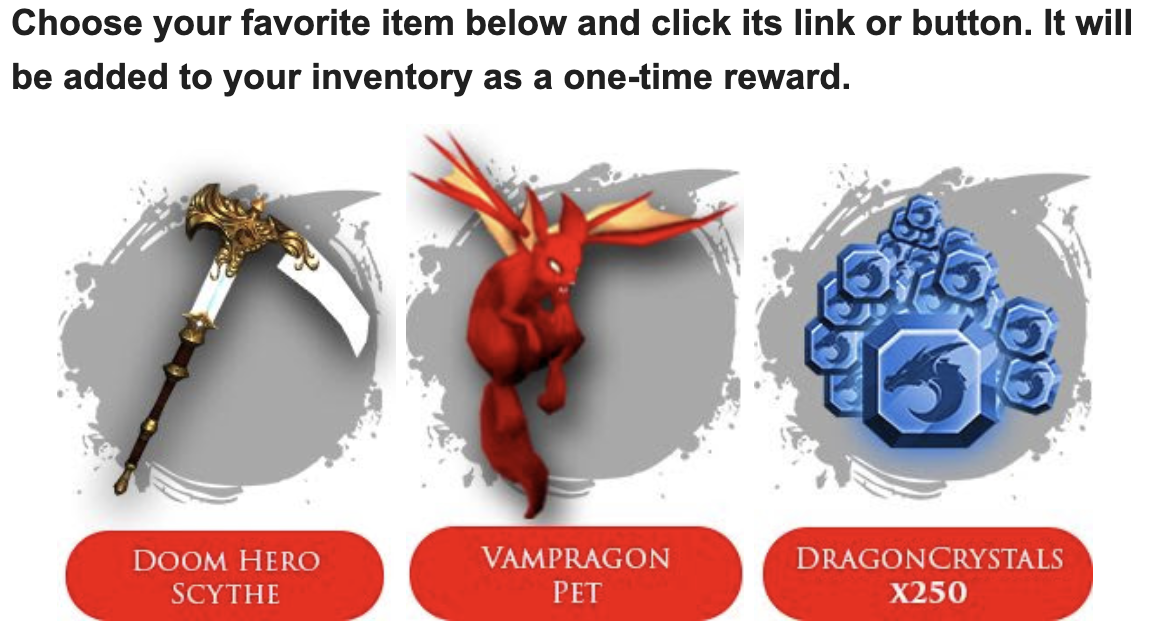
Personally, I chose the Dragon Crystals, because I wasn’t sure what the other two were and figured getting acess to the premium currencies are always a good thing.
After the player makes their choice, they’re taken to this screen:
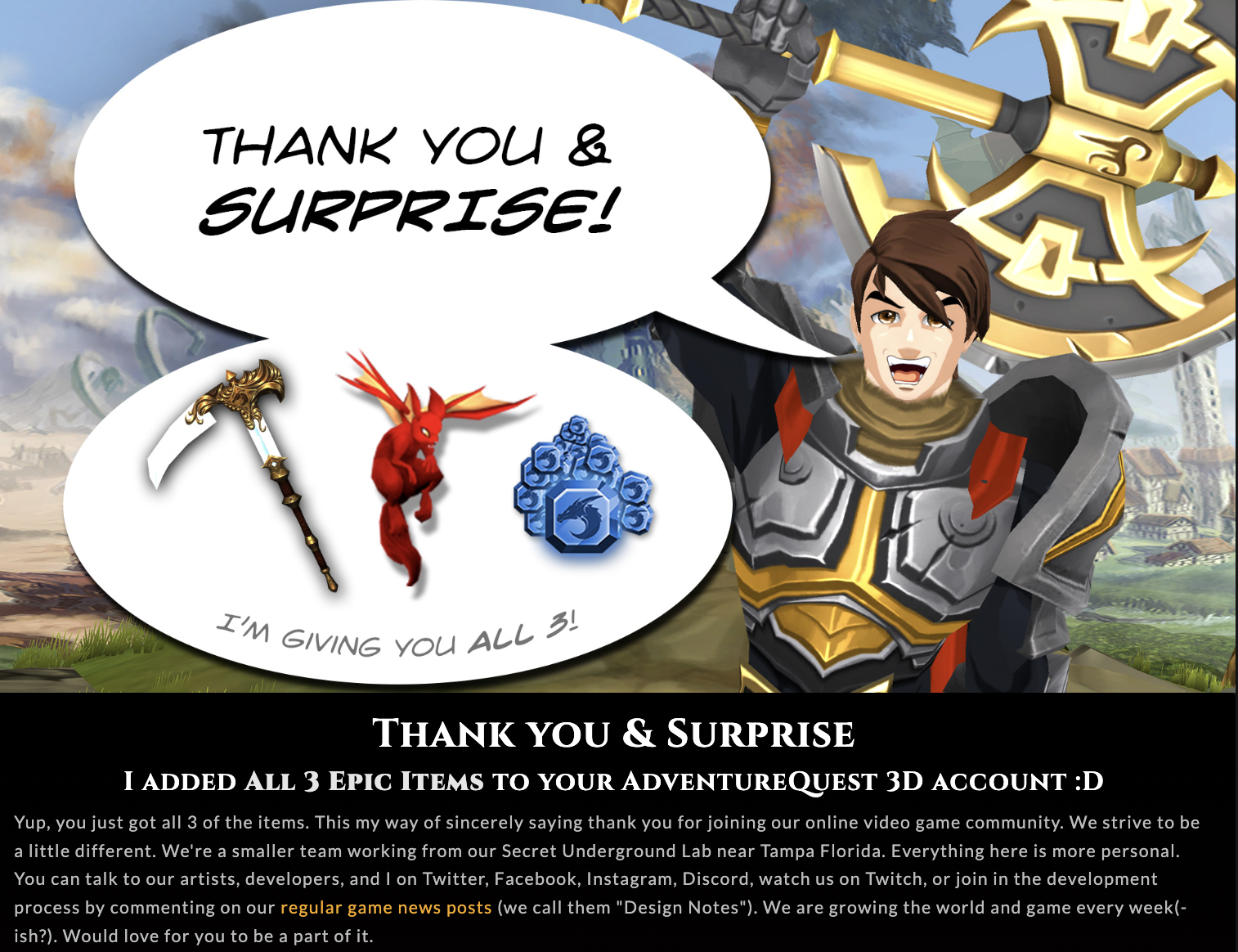
It’s a great moment, created an awesome first impression, and stuck with me to this day.
Many games give new players a set of starting items and free currency. However, if they’d just spawned them in my inventory to begin with I wouldn’t have thought twice about them. By making me choose only one, they set my expectations low. It was a bit of a difficult decision… So this reveal turned the concern I hadn’t made the right decision into surprise & delight.
This is not about Artix being super generous and giving out lots more stuff than other games would, that’s not what happened here. They just presented it 10x better.
Likewise, shopping shouldn’t feel like a salesman chasing you down and interrupting what you’re doing with a popup ad, or walling off basic features you expect most games to have by default so they can charge you for a decent quality of life.
Instead, look to make shopping fun. Make people curious about what’s in your shop. Let them find bargains, let them advance progression systems by finding things inside them, and put cool offers in the store that make people excited to spend. Not pressured, excited.
This goes out to the Product Managers too. Don’t just look for opportunities to monetize your players. Look for opportunties to give them a delightful bonus they weren’t expecting. If they’ve had a bad run of luck and have to keep repairing their gear, maybe the blacksmith says this one’s on the house.
Uma Musume is an extraordinarily high monetizing game, and one reason is because they give players more than they expect for free inbetween opening the spend ceiling for their most devoted fans. Minor maintainence you probably didn’t notice? Everyonge gets a chunk of Premium Currency as an apology. No one expects that, it costs them so little comparatively, and it just feels nice. It makes their players feel appreciated. They didn’t need to do that, so it mattered when they did it anyway.
Don’t be Spirit Airlines.

